
The multilingual regional Biber Short Story Contest for stories about reconciliation and the Biber 06 Short Story Collection with stories selected through the sixth contest were promoted at the LINK Community Development Centre in Sombor on Thursday, 23 October 2025.
Out of over 120 authors whose short stories have been published in the six Biber Collections issued to date, the following authors spoke at the promotion of Biber in Sombor: Tena Lončarević from Županja, Danijela Repman from Sombor, Irena Skopljak Barić from Vitez, and as member of the Biber 06 Contest jury, Jasna Dimitrijević from Belgrade. Radomir Radević (Biber team, Centre for Nonviolent Action Sarajevo-Belgrade) talked about the idea behind the Biber Contest. Branko Ćurčić, a writer from Sombor, moderated the discussion.
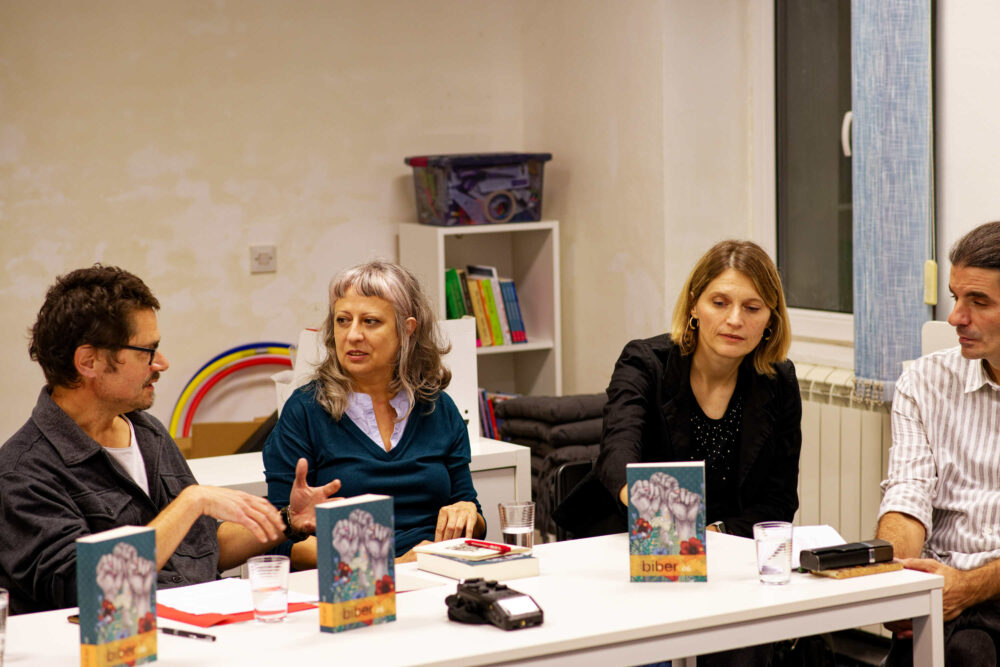
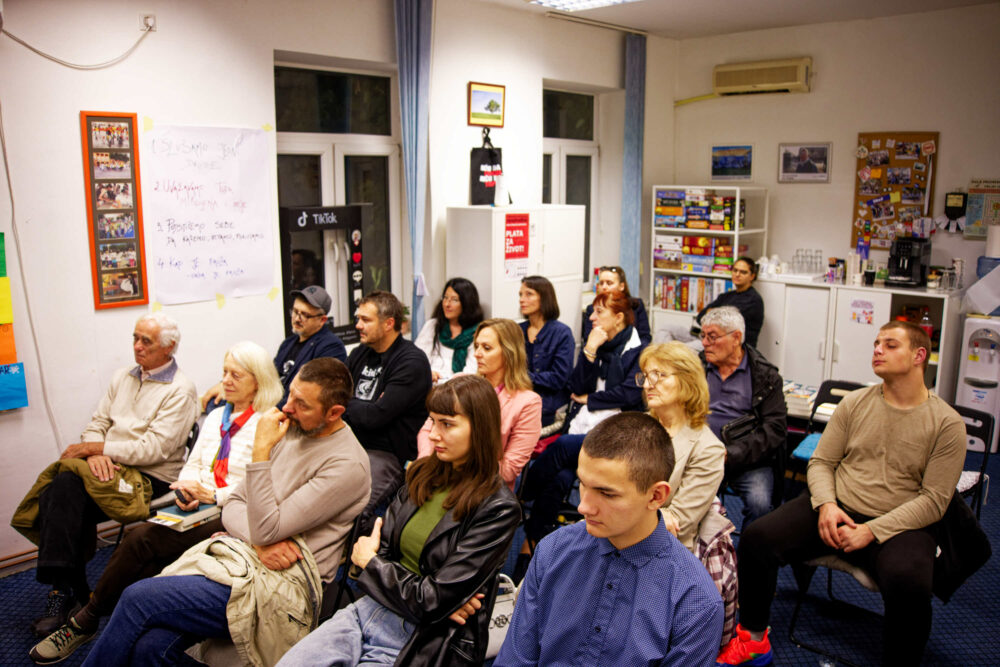
We initially wanted to organise this event at the Sombor City Library, but hospitality was withheld for unstated reasons. We are, therefore, endlessly grateful to our hosts from the Link peace organisation who opened their doors to us and made sure all guests felt welcome.
Presenting the multilingual Biber collections containing anti-war stories and stories about reconciliation, in his opening remarks Branko Ćurčić stressed that these were stories from the heart, written the way their authors felt them.
Radomir Radević spoke about Biber’s beginnings and how the initial plan was to organise one short story contest and publish one collection, but that the response was so overwhelming that the Biber team realised there was a need to tell and understand stories, to speak about reconciliation and about the war. That need has not diminished over the years, so the sixth contest was organised and the sixth short story collection published, and in December this year the seventh contest will be opened.
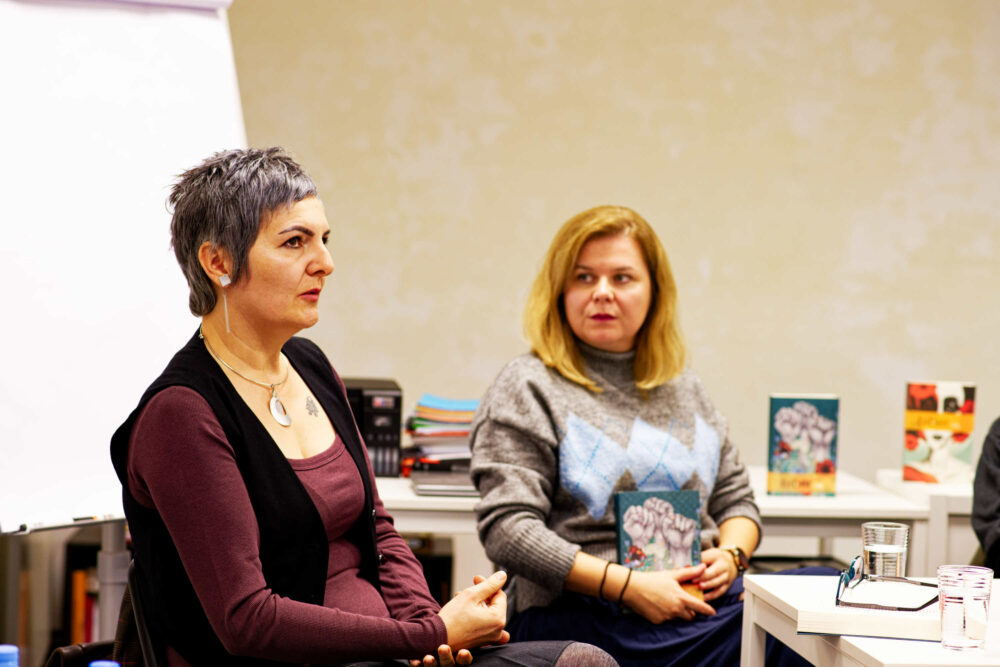
The writer Jasna Dimitrijević, who was also member of the jury and has been connected to Biber from the very beginning, said that the stories were diverse, written with various devices, in various languages, and that she found those written in dialects especially interesting. She said that the three-member jury worked for a month and spoke about how overwhelming it was to recognise the stories “that we lived and survived”. When asked about what engaged art is, she said she was not sure if writers could write something that was not engaged, even if they tried, and added, “Engaged art is the kind of art that is aware of what it can do, when there is no pretence that nothing can be done.” She also said, “It takes a lot of work. And we have to understand that each of us has something they can do. I look at this quote on the wall next to us: Who plants a tree knowing they will not sit in its shade has begun to understand the meaning of life. We have a responsibility to do something and we are responsible for what we leave behind for those that will come after us.”
Tena Lončarević pointed out, “To take a gun and point it at another human being is completely unnatural and should be unacceptable in modern civilisation.” Her story “How to Kill a Man” is about not being able to take revenge and was inspired by a true story about a man who was at a fair in Vojvodina and met someone who had been on the other side of the line from him during the recent war and who told him, “You know, I had you in my cross-sights, but I didn’t kill you.” He said that they later went for drinks together, “as is the custom in these parts”.
Irena Skopljak Barić, who was born in Zenica, lived in Vitez in BiH, grew up in Trogir where her family had fled, studied in Zagreb and now lives in Vrobovec near Zagreb, told the gathering, “Wherever I go, I feel both that I am a refugee and that I am at home. I was 10 years old. I experienced the whole war as a tragedy for children.” She read part of her story “Birds” that revolves precisely around this tragedy. Irena also spoke about how she feels like she has known the Biber team members and the authors she has met for a hundred years already: “I feel like we know each other.” She underlined that we can all work on our micro levels. In her town, she is running a regional contest for bitter stories.
Danijela Repman, an author from Sombor and winner of the third prize at the most recent contest for her story “Erzähle mir etwas über dich”, said that it seemed incredible to her that even today this kind of conversation about reconciliation and stories about reconciliation were being perceived as subversive in our country and this town. She talked about how the people who shape our public space have a great responsibility and they are abusing it. She particularly focused on the interesting fact that all three authors present and the moderator work in education and added, “We have an opportunity at a micro level to set things straight.” What Irena had said made her recall how as a child she came home from school one day with a piece of paper where she was supposed to write in her nationality and the discomfort that caused. She also said, “We have power as individuals. If you move just one person to see that nothing is black and white, you fight those narratives, that’s exactly what we’re doing here.”
At the end, Radomir invoked Faulkner’s thought that the past is never dead, it’s not even past, and explained, “The aim is to understand the other. For me, Biber is a generator of empathy.”
The sixth Biber Contest was open from December 2023 to May 2024. A total of 490 stories were submitted. The jury comprising Almin Kaplan, Jasna Dimitrijević and Tanja Stupar Trifunović decided on the winning stories and those that would be included in the collection. The multilingual collection was published in March this year.
Biber is a short story contest for engaged stories in Albanian, Bosnian, Croatian, Macedonian, Montenegrin and Serbian. The short story collections we presented in Sombor resulted from the Biber Contests for short stories about reconciliation in the context of the legacy of the wars and violence in the countries of former Yugoslavia, as well as stories contributing to better understanding among people, reducing hatred and dismantling prejudice, anti-war stories, stories about dealing with the past, deconstructing images of the enemy, empathy, brave stories that dare walk in the “enemy’s” shoes, stories that push boundaries and open up the way to build a more stable, safer and freer future for all. The contest is organised by the Biber team of the Centre for Nonviolent Action Sarajevo|Belgrade.
Electronic editions of all Biber Collections can be downloaded for free from this website.