
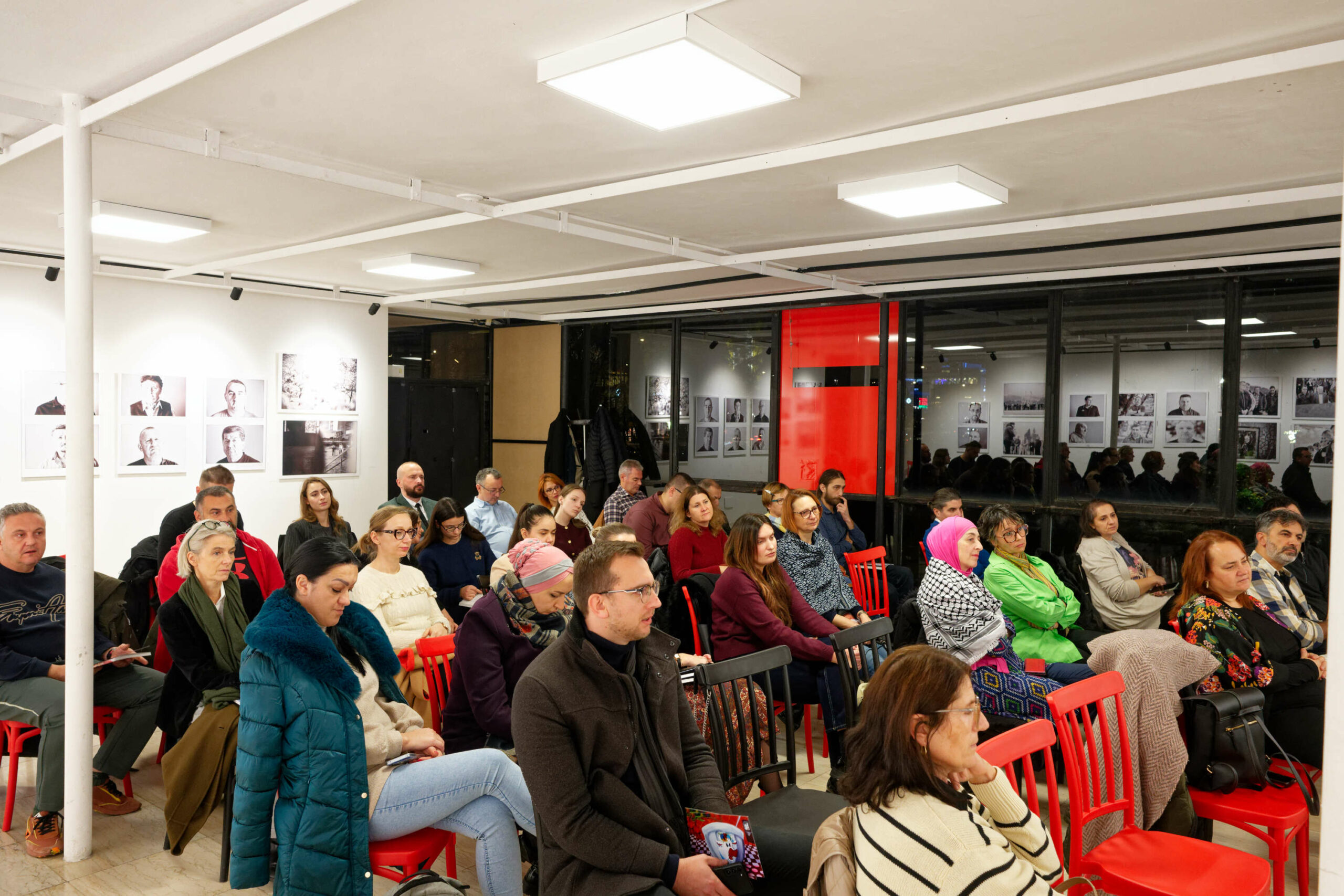
On Thursday, 20 November 2025, the Centre for Nonviolent Action promoted its book We Come in Peace and opened the accompanying exhibition at the Historical Museum of Bosnia and Herzegovina.
The book We Come in Peace is the result of experiences that the Centre for Nonviolent Action has gained over more than 20 years of working with veterans from the region on peacebuilding. The book is divided into two parts: one focuses on the potential of war veterans for peacebuilding and the experiences gathered by the Centre for Nonviolent Action, and the other introduces the people who make that work possible.
Alongside the book promotion, an accompanying exhibition of photographs by Nenad Vukosavljević was also opened. The exhibition will be on display at the Historical Museum of BiH until 27 November 2025, with free admission
A discussion held at the Historical Museum included war veterans Đoko Pupčević (Šamac), Mirko Zečević Tadić (Brčko), Adnan Hasanbegović (Sarajevo) and peace activist Nenad Vukosavljević (Belgrade).
Nenad Vukosavljević pointed out that the book We Come in Peace gives an overview of the work of the Centre for Nonviolent Action with war veterans:
“The truth is that we won’t agree on everything in that work, but we have common ground in that we are committed to ensuring that the terrible, irreparable loss of life we experienced in the war is never repeated in the future, and that the path to that goal begins with showing respect for all victims and an equal, non-selective approach to the suffering and pain that people experienced.
The Center for Nonviolent Action began working with war veterans on peacebuilding in 2002. A mixed group of war veterans, former members of ARBiH, HVO, HV, VRS and JNA/VJ, have so far participated in a host of various activities aimed at dealing with the past and peacebuilding.
Among other things, as a mixed group of war veterans they have visited more than 50 sites of suffering and attended public commemorations in Gornji Vakuf, at Site 715 near Zavidovići, in Stog near Vozuća, in Novi Grad/Bosanski Novi, Sanski Most (Hrastova glavica), Sijekovac near Brod, Laništa near Brčko, Trusina near Konjic, Ahmići near Vitez, Grabovica, Uborak and Sutina near Mostar, Briševo and Zecovi near Prijedor, Korićanske stijene, Stupni Do near Vareš, Boderište near Brčko, the bridge over the Sava in Brčko, Bradina near Konjic, Skelani near Srebrenica, the Silo in Tarčin near Hadžići, Lozje near Goražde, Rogatica (BiH), then in Grdelička klisura near Leskovac, Varvarin near Kruševac, Aleksinac (Serbia), as well as in Herceg Novi (Montenegro) and Pakrac, Varivode and Gošić near Knin (Croatia).
The book chapters were contributed by Amer Delić, Ivana Franović, Nedžad Novalić and Nenad Vukosavljević.
The editors were Ivana Franović, Davorka Turk and Martina Fischer.
The electronic edition of the book is available on our website and is free to download.
Adnan Hasanbegović, a war veteran from Sarajevo, was one of the first veterans to use his wartime experience as a resource for peacebuilding. Shortly after the end of the siege of Sarajevo and the signing of the Dayton Peace Agreement, Adnan initiated peace meetings.
“There was a huge need, and I would also say plenty of room for veterans to get involved in peace activities. They enjoyed a high degree of credibility in their communities, but part of civil society didn’t perceive them as having potential. And on the other side, among the veterans themselves, there were those who were prepared to get involved, they wanted to make a contribution after the war to ensure things got better in our societies, they wanted to be remembered for something other than war. There were many honourable people who were ready to confront issues in their communities, who were ready to take that step,” said Adnan Hasanbegović.
He also added that he still considers the Dayton Peace Agreement to be a positive historical event.
“It brought some disappointments, true, but it was probably the only way to end the war here. The disappointments relate more to its implementation after the war, but it was the only compromise possible at the time. It stopped the war and the peace has lasted for 30 years now. It is up to us and the new generations to keep improving that peace,” said Hasanbegović.
Đoko Pupčević, a veteran of the Army of Republika Srpska (VRS), said that going to sites of suffering and commemorations is always emotionally difficult for him, but that he’s not giving up.
“The thing that’s most painful is when you see that those who perished were mostly young people, thousands of them missing from their families, their communities. It’s especially difficult when you visit the site of a crime for which your side was responsible, someone went there in my name and committed that crime. That’s always really painful for me,” said Pupčević.
Mirko Zečević Tadić, an HVO veteran from Brčko, described how at one point people couldn’t believe that he, as a Croat, had come to pay his respects to Serb victims.
“I had to show them my ID before they’d believe me. I understand that some people will never be able to make that step, which is why it’s important to continue this work, to show ourselves and others that this path is possible, that you can go and pay your respects to all victims,” added Mirko Zečević Tadić.
The Centre for Nonviolent Action Sarajevo-Belgrade is a regional peace organisation with a mission to build lasting peace in the region of the former Yugoslavia. It pursues that mission by promoting a culture of nonviolence, dialogue and trust-building among individuals and groups, and through work on constructive dealing with the past, which is a key factor in peacebuilding.