
Society doesn’t change on its own. Change is made by people who dare to imagine a different world, said bell hooks, the feminist theorist and activist. Her words perfectly capture the feeling I have come away with after the third phase of the Training of Trainers for Peacebuilding, which was held in Tetovo from 10 to 20 July 2025.
Still, let’s rewind a few steps…
The start of the Training of Trainers was at the beginning of April in Ulcinj, a town where 22 people met, got to know each other and connected, created a safe space and established mutual trust. In Ulcinj, we selected the topics that the participants intended to cover in their workshops, but this time as trainers and not participants, as well as the teams they wanted to work in. The topics that the participants were interested in included: non-violent communication, gender-based violence, trauma, non-violent action and activism, memorialisation, prejudice and discrimination, conflicts…
Preparations
In the second phase of the Training of Trainers, during May, we met in Sarajevo and Belgrade. Team members gathered with the support of the training team, and worked diligently on designing their workshops. The ones in which they would take on the role of trainers and guide the group through a topic from start to finish. We worked hard at team meetings, there were many dilemmas, fears, joys, expectations, but also worries: how important was workshop preparation, how do we get the content we expect, how do we communicate within our team while running the workshop, how do we keep to the time schedule, what if we make a mistake, what to do if the group is “silent”, etc. These are the kinds of questions that require support from the group and the training team, and the answers provide an excellent basis for designing and later running the workshop.
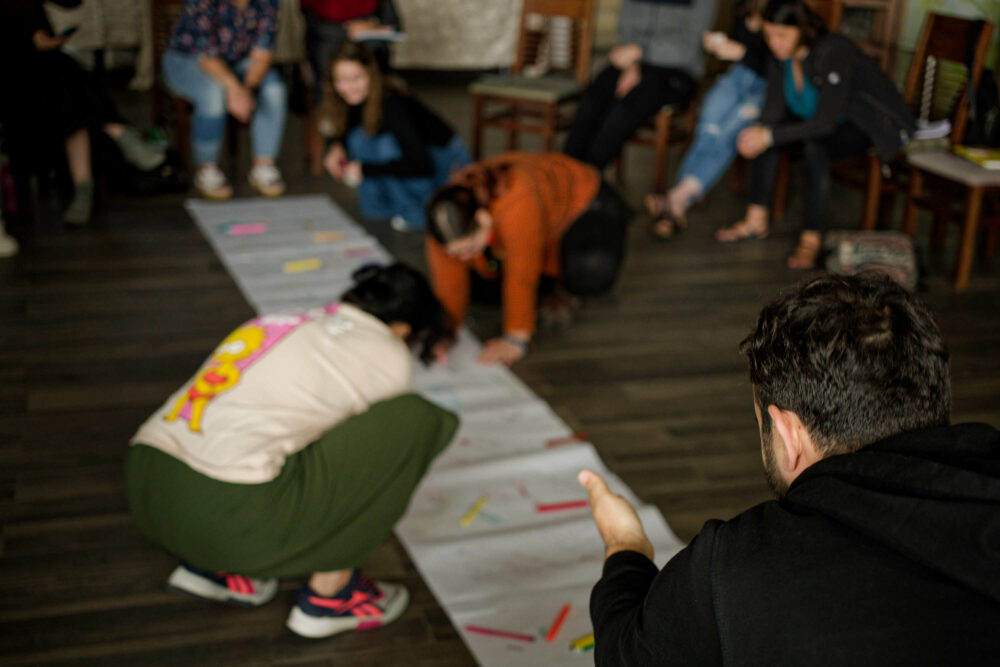
“Ready, Steady, Go!”
Following the May meetings in Sarajevo and Belgrade, in July we travelled from various parts of the former Yugoslavia to Macedonia and the town of Tetovo at the foot of Popova Šapka mountain. Hotel “Scardus” at Popova Šapka provides a unique experience of peace and quiet, surrounded by beautiful nature and with excellent working spaces and group accommodation.
The plan was to divide the third phase of the Training of Trainers into two parts. In the first part, the participants would run their workshops. The second part of the training would include an evaluation of the role of trainer and the difficulties encountered in peace work, as well as examining topics such as the ethics of peace work, non-violence, the importance of feedback, gender roles in society, etc.
We faced a few difficulties at the very beginning: one of the participants had cancelled and two others would be arriving late and miss the first few days of the training. This had an impact on the group work dynamics, but together we managed to overcome these obstacles.
11 July was the first working day of training. We began with a minute of silence for all the victims of the Srebrenica genocide and by reading an inspirational text written by Nejra Lilić who was a participant in our Student Training in 2019. The significance of the date weighed heavy on the minds of everyone within the group but we didn’t shy away from it, we let this feeling remind us why we were there and why we’re dedicated to building peace, in the present and in the future, why we’re connecting into a regional group of people who will contribute to changing our societies.
The workshops that the participants held were based on the methodology that CNA practices, but also on other innovative methods and creative solutions. My colleague Nedžad Novalić previously wrote: “The training for trainers brings a different dynamics and a different kind of experience, offering us the opportunity to alternate between letting go and being guided through the training, on the one hand, and pulling back and watching the process of guidance or becoming guides ourselves.”
The workshops that were held were designed, in layman’s terms, to have a beginning, middle and an end. After each workshop, we could all sit down together and hear what we had personally experienced, both as participants and as trainers. This gave us the opportunity to provide support to each other, but also to hear what went well, and where perhaps mistakes were made. The first step in learning is recognising your own mistakes, but there was also an opportunity to step out of established patterns where we compete to be better than others. This allowed us to step back from our own interests and open up to the prospect of actively participating in building a more just society by being kinder towards others, but also ourselves.
As the days progressed, it was clear the participants were working diligently, reflecting, articulating their fears, insecurities, discussing their expectations, and at the same time seeking support from the group. There was a real sense of solidarity and togetherness.
Various emotions intertwined, there was excitement, but also stress. Overheard asides included: everything will be OK, we’re here for you; you have our support; we care… and there were many smiles and hugs.
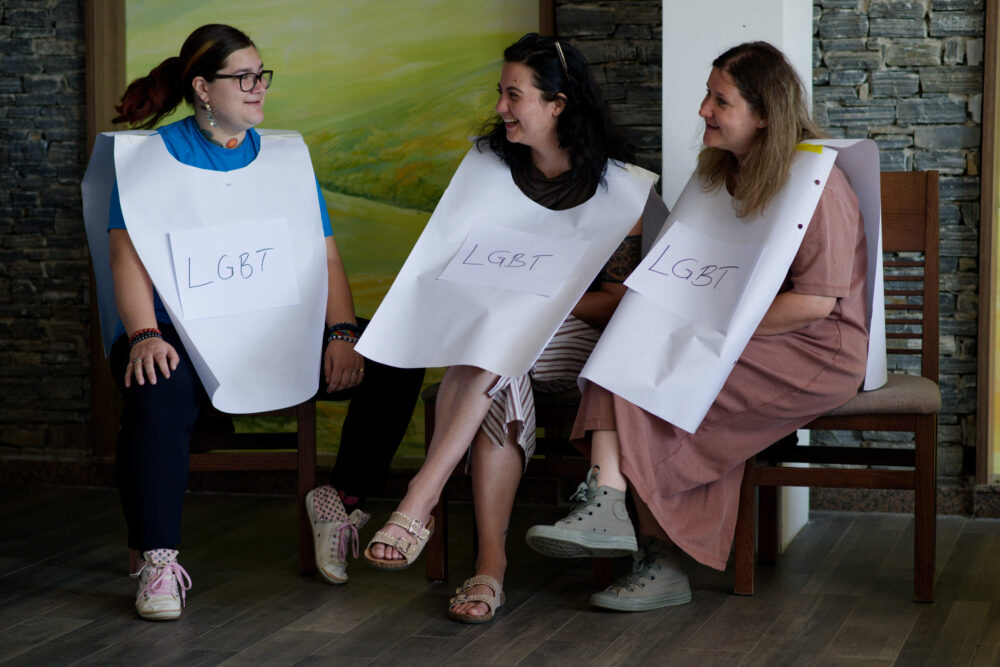
Allies
After an exhausting four days, in which ALL of us did EVERYTHING, being both trainers and participants, there was a sense of relief after a free day that was included right in the middle of the training. That feeling of relief contributed to a renewed readiness to engage in conversations about conflicts in a constructive way and through the practice of feedback. Personal, but also societal change often begins when someone says, “This isn’t right”. That simple statement provides the opportunity for us to stop and listen to the other side, to recognise our own behaviour, but also the behaviour of the other side, to hear the hurt, to receive constructive criticism, but also to provide it. An opportunity based on the fact that in saying so we are not each other’s enemies, but allies who will not be neutral in situations of injustice.
With this encouragement, we embarked on an examination of what we call the ethics of peace work. How can it be our starting point and provide a framework of values for peace work, activism and mutual cooperation? We kept returning to a question that we all personally face: What is it that I stand for in my work? How do I deal with value differences, how should I react in value conflicts, and in everything we do, were do we see the limits of non-violence?
Finally, we talked a lot about the difficulties of being a trainer, we discussed questions ranging from the technical aspects of running a training to fundamental dilemmas we have not only when it comes to peace work, but things we struggle with in everyday life. Many questions remained open, for some we don’t have answers, for others we need more time to sort them out.
In the third phase, the team of trainers (Ivana Franović, Nenad Vukosavljević, Nedžad Novalić and Tamara Zrnović) was joined by our long-time colleague and friend Ana Bitoljanu, who divides her time between Skopje and Gnjilane/Kosovo. Ana was a huge support to su, she fit in easily with the group, and her special sense of how to approach people helped her connect with each participant. Also, at this stage the team of trainers had to deal with the difficulty of one member of our team having to leave after the free day in the middle of the training. This kind of difficulty is always challenging for the team of trainers and the running of the training, but it is also an opportunity to learn. It makes us come up with the way and the strength to see the training through, remain dedicated to the group and achieve the set goals.
We also owe special thanks to our hosts at Hotel Scardus (Popova Šapka), all the wonderful people who made our work and stay feel like home.
At the end of the training, we put together a wall newspaper with the question of What are our needs going forward? And that is what we plan to work on next… to examine ourselves, our local communities, but also our broader societies, thinking about the kinds of changes we want to see and be a part of…